


.png)


Try Default

See how revenue teams automate revenue operations with Default.

Key Takeaways
- LeanData integration is a Salesforce-native routing engine that matches Leads to Accounts and enforces assignment logic directly inside Salesforce, without middleware or sync delays.
- It’s built for account-based, territory-driven B2B sales models, where routing accuracy directly impacts speed-to-lead, rep ownership, and pipeline visibility.
- Successful implementation requires clean CRM data, defined routing strategy, and RevOps governance (it’s not a plug-and-play automation)
- LeanData delivers the most ROI in Salesforce-centric enterprise environments where routing errors create duplicate Accounts, ownership conflicts, and MQL-to-SQL lag.
LeanData integration is a Salesforce-native routing engine that enforces assignment directly inside your CRM. When the rules are defined and the data is clean, it eliminates routing latency and protects ownership integrity at scale.
In this guide, you’ll learn:
- How it works inside Salesforce
- What’s required for clean deployment
- Where it delivers the most impact
What is LeanData integration?
LeanData integration is a Salesforce-native routing engine built directly on standard Salesforce objects, including Leads, Contacts, Accounts, and Opportunities. It executes assignment logic inside the CRM in real time, rather than syncing data between external systems.
Designed for account-based sales models, LeanData matches Leads to Accounts and enforces territory ownership at scale. It doesn’t replace Salesforce; it extends it with structured routing governance.
Advantages of LeanData integration
Core benefits for RevOps and GTM teams:
Real-time lead-to-account matching
Matches inbound Leads to existing Accounts before assignment using domain logic, fuzzy matching, and hierarchy rules. This prevents duplicate Accounts, preserves Account Owner routing, and keeps ABM engagement consolidated instead of fragmented across records.
Territory and ownership enforcement
Applies dynamic routing across regions, segments, and named accounts rather than relying on static Assignment Rules. This reduces rep disputes, protects enterprise coverage models, and keeps routing aligned as territories evolve.
SLA-driven accountability
Triggers alerts, tasks, and escalation paths when follow-up thresholds are missed. RevOps can enforce response SLAs, reduce MQL-to-SQL lag, and prevent high-intent leads from aging out in queues.
CRM-native execution
Runs directly inside Salesforce, so assignment happens instantly without sync delays or middleware failure points. That means fewer routing gaps, cleaner attribution, and more reliable downstream automation.
Built for account-based complexity
Aligns multiple Leads and Contacts to a single Account, supporting ABM execution without breaking ownership or hierarchy rules. This improves visibility into buying-group activity and keeps outreach coordinated at the Account level.
Taken together, these advantages give RevOps a routing layer that is enforceable, auditable, and scalable. You reduce manual routing work, protect ownership integrity, and keep pipeline moving without sacrificing governance.
Top platforms that integrate with LeanData
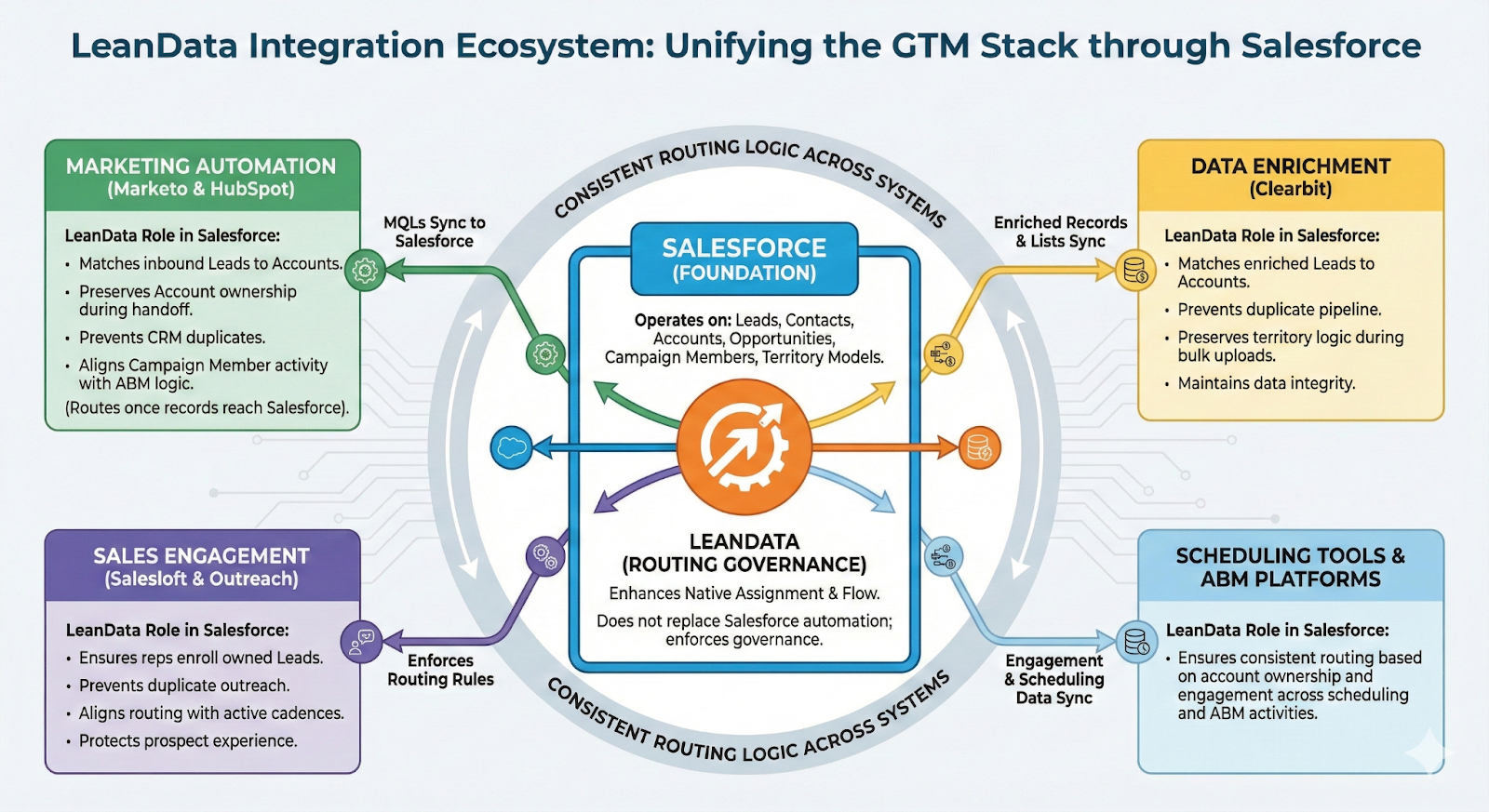
LeanData sits inside Salesforce but influences the entire GTM stack. It connects marketing automation, sales engagement, enrichment, and scheduling tools to ensure routing logic remains consistent across systems.
Salesforce
Salesforce is the foundation of LeanData integration. LeanData runs directly on Leads, Contacts, Accounts, and Opportunities, enforcing routing inside the CRM.
Companies that respond within 1 hour are 7x more likely to qualify a lead. Routing delays directly impact pipeline velocity.
Marketo (adobe Marketo engage)
Marketo syncs MQLs into Salesforce. LeanData then:
- Matches Leads to existing Accounts
- Preserves named Account ownership
- Prevents duplicate Account creation
ABM alignment is critical: 72% of companies report greater ROI from ABM than other types of marketing. Fragmented routing undermines that advantage.
HubSpot
In Salesforce–HubSpot stacks, HubSpot captures and syncs Leads. LeanData enforces:
- Territory-based assignment
- Account-level ownership
- Conflict-free CRM routing
Inbound spikes amplify routing risk. Without governance, ownership disputes and SLA misses increase quickly.
Salesloft / Outreach
LeanData aligns CRM ownership with sales engagement cadences. It ensures:
- Reps enroll only owned Leads
- Duplicate outreach is avoided
- Assignment logic matches sequencing workflows
Speed-to-lead matters: faster follow-up significantly increases qualification rates. Clean ownership prevents SDR conflict and protects prospect experience.
Clearbit (Data enrichment)
Enrichment tools create records at scale. LeanData:
- Matches enriched Leads to existing Accounts
- Prevents duplicate pipeline creation
- Preserves territory logic during bulk uploads
Data quality is fragile. The estimated cost of bad data ranges from 15%–25% of revenue for most companies. As enrichment velocity increases, routing governance must scale with it.
Setup requirements for LeanData integrations
LeanData is not plug-and-play. It enforces routing inside Salesforce, but it doesn’t define your GTM strategy or repair weak data models. Before activation, align on the following:
LeanData works best when routing logic and CRM governance are already structured.
How LeanData integration works (step-by-step)
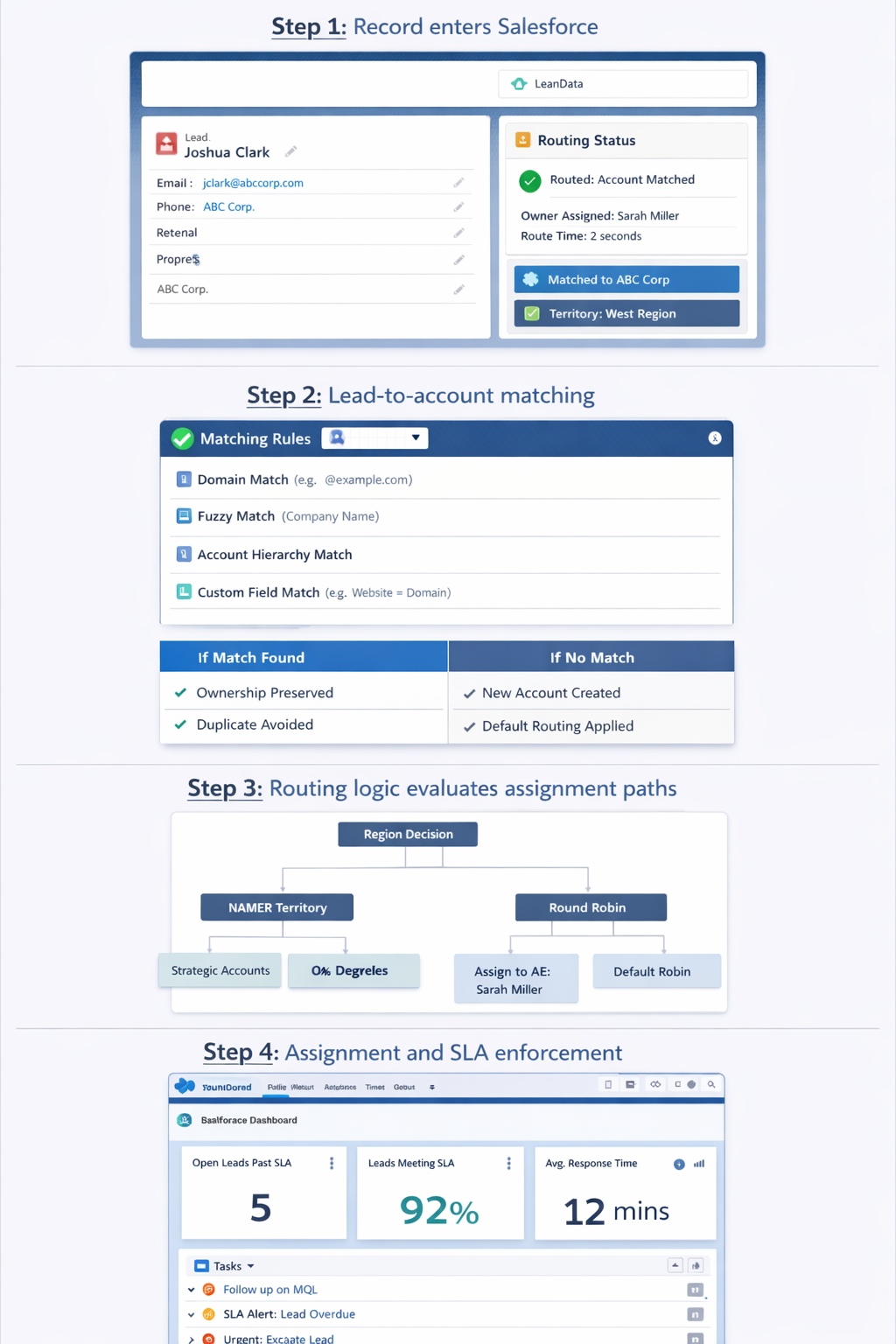
LeanData runs inside Salesforce and evaluates records the moment they’re created or updated. Routing logic executes before downstream workflows, ensuring ownership, matching, and SLA enforcement happen instantly.
Routing flow overview
Step 1: Record enters Salesforce
Routing begins the moment a record is created or updated inside Salesforce.
Common trigger sources:
- Marketing automation sync (Marketo, HubSpot)
- Enrichment uploads (e.g., Clearbit lists)
- Event or webinar imports
LeanData evaluates the record instantly inside Salesforce (no middleware delay).
Step 2: Lead-to-account matching
Before assignment, LeanData attempts to match the incoming Lead to an existing Account.
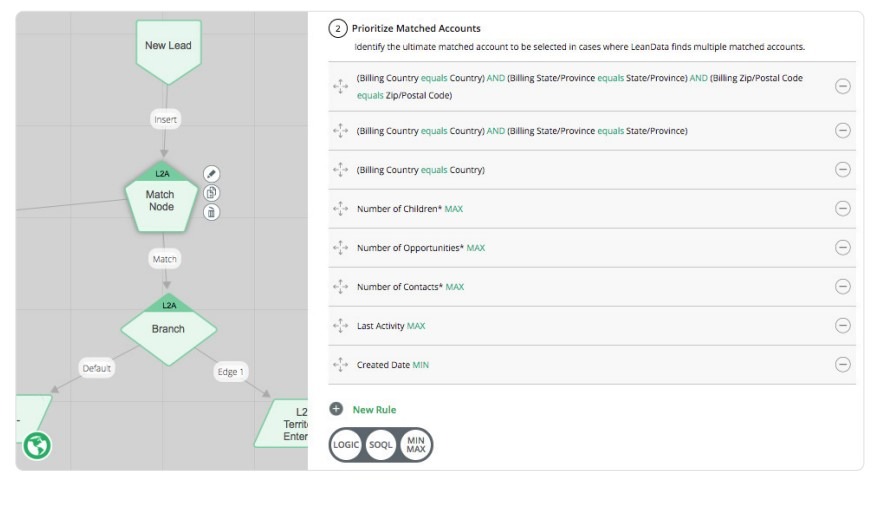
Matching logic may include:
- Exact or partial email domain matching
- Fuzzy company name logic
- Account hierarchy alignment
- Custom field criteria
This step prevents account fragmentation (especially critical in enterprise and ABM models).
Step 3: Routing logic evaluates assignment paths
Once matching completes, LeanData applies structured routing rules based on:
- Territory (region, vertical, segment)
- Named account lists
- Existing Opportunity ownership
- Round-robin or weighted pools
This replaces static Assignment Rules with structured routing paths aligned to your GTM model.
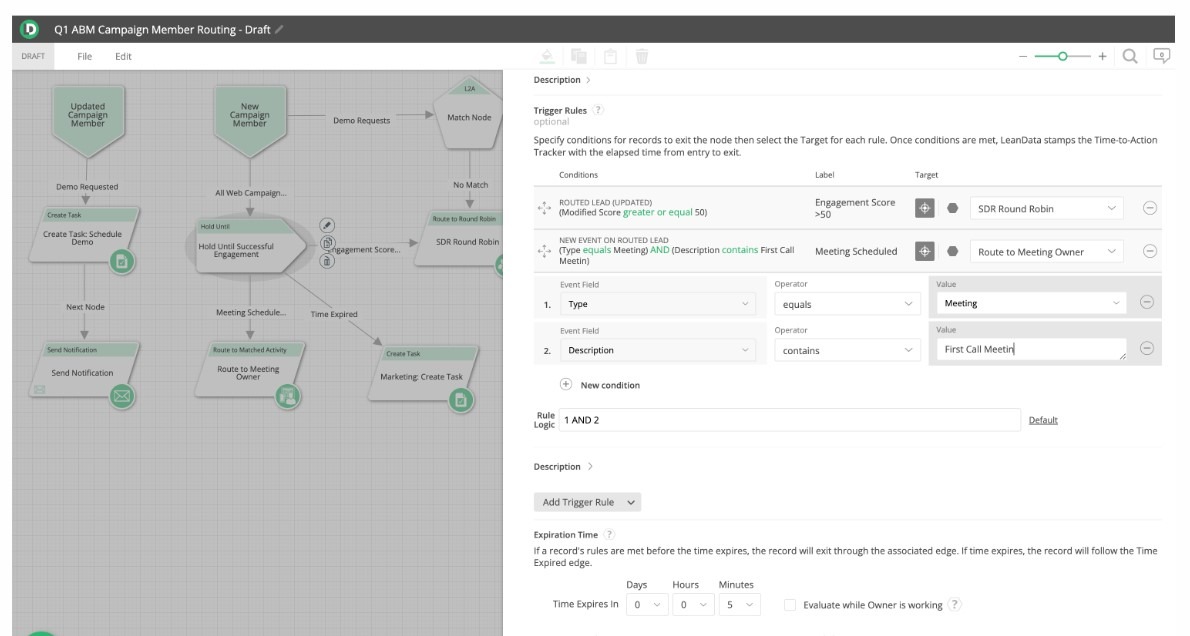
Outcome: Assignment reflects real ownership logic, not default queues.
Step 4: Assignment and SLA enforcement
When criteria are satisfied, LeanData:
- Assigns the correct owner
- Creates tasks or notifications
- Starts SLA countdown timers
- Triggers escalation rules if thresholds are missed
Routing becomes measurable and auditable, not just automated.
Use cases: How GTM teams put the integration to work
LeanData delivers the most value when routing complexity surpasses what native Salesforce Assignment Rules can manage.
Below are two common scenarios where RevOps teams use it to protect pipeline speed and ownership governance.
Enforcing account-based routing in enterprise ABM
An enterprise B2B company runs ABM campaigns targeting named Global 2000 accounts. Multiple stakeholders from the same Account engage across channels.
Without structured lead-to-account matching:
- New Leads create duplicate Accounts
- SDRs contact prospects they do not own
- Account Owners lose visibility into buying group activity
- Attribution fragments across disconnected records
With LeanData integration:
- Inbound Leads match to existing Accounts using domain and hierarchy logic
- Ownership is preserved based on named account rules
- Routing prioritizes the Account Owner over round-robin pools
- Campaign engagement rolls up at the Account level
Result:
- Fewer ownership conflicts
- Faster MQL-to-SQL conversion
- Clear attribution across the full buying committee
Reducing MQL-to-SQL routing delays during inbound spikes
A SaaS company launches a webinar campaign generating 3,000+ Leads in 48 hours. Native routing breaks under volume:
- Leads sit unassigned in queues
- Territory rules misfire
- SLA follow-up windows are missed
- SDR distribution becomes uneven
With LeanData:
- Routing graphs evaluate segmentation instantly inside Salesforce
- Leads distribute across defined SDR pools
- SLA timers trigger automatically
- Escalations notify managers when thresholds are breached
Result:
- Routing time drops from hours to seconds
- SLA compliance improves
- Lead conversion velocity holds steady during peak demand
Who should use LeanData integration?
LeanData integration is best suited for GTM teams operating in Salesforce-centric environments where routing accuracy directly affects pipeline performance.
It’s typically the right fit for:
- Enterprise B2B organizations managing high inbound volume, complex territories, and multi-stakeholder buying groups
- Account-based sales and marketing teams that must preserve named account ownership and hierarchy integrity
- Salesforce-first environments where assignment, attribution, and opportunity ownership live inside the CRM
- RevOps-led teams with the resources to design routing logic and enforce SLA governance
LeanData delivers the strongest ROI when routing complexity exceeds what native Assignment Rules or basic Flow automation can manage consistently.
When LeanData integration may not be the best fit
LeanData is built for structured, account-based routing. In simpler environments, it may introduce more configuration than necessary.
Leandata may not be ideal for:
- SMB teams with low inbound volume and straightforward territory rules
- Multi-CRM environments where Salesforce is not the single source of truth
- Product-led growth models driven by in-app activation rather than SDR follow-up
- Teams needing basic automation, not account hierarchies, SLA enforcement, or advanced segmentation
If routing complexity is minimal, native Assignment Rules or Flow may be sufficient as a Leandata alternative.
Simplify your lead routing integration with Default
LeanData strengthens Salesforce routing, but routing only works when the underlying CRM data and lifecycle triggers are consistent.
If enrichment is incomplete, duplicates slip through, or stages aren’t enforced, even the best routing graphs create exceptions, ownership conflict, and attribution noise.
Default automates the hygiene and workflow layer behind routing: scheduled enrichment, automated deduplication, and enforced lifecycle transitions so Salesforce stays clean, and routing stays reliable.
LeanData governs assignment. Default keeps the system trustworthy at scale.
Book a demo to see how Default reduces routing exceptions and protects pipeline velocity.
Conclusion
Former pro Olympic athlete turned growth marketer. Previously worked at Chili Piper and co-founded my own company before joining Default two years ago.
Run revenue as an engineered system
Revamp inbound with easier routing, actionable intent, and faster scheduling