


.png)


Try Default

See how revenue teams automate revenue operations with Default.

Key Takeaways
- An SDR to AE handoff works when the AE can run the first call immediately with qualification, deal context, intent, and a clear next step (not just a meeting invite).
- Handoffs fail when the process is inconsistent: unclear “qualified” criteria, missing context, messy ownership, and slow follow-up lead to no-shows, shallow discovery, and pipeline that stalls.
- High-conversion handoffs use a repeatable system: one qualification framework, deterministic routing, a standard handoff package in the CRM, and follow-up SLAs tied to meeting-to-opportunity conversion.
- Automation makes this scalable by enforcing routing and required fields, triggering instant AE action, and escalating missed SLAs so qualified meetings convert into real opportunities more reliably.
If your SDRs are booking meetings but AEs aren’t turning them into pipeline, the problem usually isn’t effort; it’s the handoff.
SDR to AE handoff best practices are simple: the AE should receive a clean, actionable package (qualification + context + next step) instantly, with clear ownership and fast follow-up enforced.
When that system isn’t defined, handoffs degrade as volume grows: context gets lost, leads sit unaccepted, and conversion drops.
This guide gives you the playbook: best practices, a checklist, and the metrics to find the leak and fix it fast.
What is an SDR to AE handoff?
An SDR to AE handoff is the process of transferring a sales-qualified lead or booked meeting from a Sales Development Rep (SDR) to an Account Executive (AE) so the AE can run discovery, progress the deal, and close.
A strong handoff ensures the AE receives enough usable information to take action immediately, including:
- qualification details (based on your team’s framework)
- deal context (pain, use case, urgency, stakeholders)
- any verified buying signals or intent
- a clear objective for the first call and the agreed next step
At scale, this is a conversion-critical system that directly impacts pipeline quality and revenue efficiency.
Why SDR to AE handoffs fail at growing companies
As your GTM motion scales, handoffs break because what worked informally cannot survive higher volume, more reps, and more complexity. The downstream impact is consistent: slower follow-up, weaker discovery, lower meeting quality, and pipeline leakage.
Common failure points include:
- Inconsistent qualification standards
SDRs optimize for meetings booked, while AEs need leads that match opportunity criteria. This creates noisy pipeline and more “first calls” that never convert. - Missing deal context
Critical details like pain points, use case, urgency, stakeholder map, and prior objections do not transfer cleanly. AEs restart discovery from zero, which reduces conversion and credibility. - Routing and ownership confusion
Leads get reassigned, sit unaccepted, or land with the wrong AE due to territory, segment, or account ownership edge cases. Momentum dies in the gap. - Slow AE response times
Delayed follow-up lowers show rates and reduces the chance the AE can control the narrative. Even qualified leads cool off fast when the transition is slow. - No measurable handoff SLAs
Without clear timing expectations and accountability, follow-up becomes “best effort.” That makes pipeline performance harder to predict and harder to improve.
SDR to AE handoff best practices
High-conversion handoffs aren’t about “better communication.” They’re a system.
The goal is simple: AEs should start the first call with clean qualification, full context, and a clear next step.
Here are seven best practices to standardize handoffs, protect speed-to-lead, and increase meeting-to-opportunity conversion.
#1: Standardize qualification with a shared framework
If SDRs qualify based on “interest” but AEs qualify based on “opportunity,” your pipeline will stay noisy. Meetings get booked, but fewer convert because the AE has to re-do qualification on the call.
Use one shared qualification framework (MEDDICC, SPICED, BANT, or your internal model) and define what “qualified” means in your exact GTM motion. The key is consistency: the same inputs, captured the same way, every time.
At minimum, SDRs should capture:
- the business problem (in the prospect’s words when possible)
- why now (trigger event, urgency, or timeline driver)
- who is involved (decision-maker and key stakeholders)
- what success looks like (desired outcome and impact)
#2: Route leads using clear, automated rules
As teams grow, manual lead assignment creates delays and mistakes. Even small lead routing errors (wrong territory, wrong segment, wrong account owner) introduce “lead limbo,” where qualified leads sit untouched or bounce between reps.
Routing should be deterministic and based on objective rules such as:
- territory and region
- segment (SMB, mid-market, enterprise)
- account ownership and existing relationships
- product line or use case
- intent or priority score (when applicable)
When routing is consistent, the right AE receives the lead fast, accepts ownership confidently, and follows up before momentum decays. That directly improves show rates and meeting-to-opportunity conversion.
#3: Pass full context, not just a meeting booked
When context is missing, AEs are forced to restart discovery, ask redundant questions, and re-establish credibility. That slows the deal and reduces the chance the first call turns into a qualified opportunity.
A strong handoff passes:
- what triggered the prospect’s interest
- the primary pain point or problem to solve
- the validated use case and desired outcome
- any known objections, constraints, or blockers
- what the SDR already confirmed and what still needs discovery
The more context the AE inherits, the more focused the first call becomes, and the higher the likelihood it converts into real pipeline.
“Your SDR needs to create a proper handoff brief that the AE reviews before every meeting… The brief should include the prospect's exact pain points in their own words, what they currently use for solutions, their timeline, and any specific details they mentioned about their business.”
— u/erickrealz, r/EntrepreneurRideAlong
#4: Define ownership and acceptance explicitly
A lead is not handed off just because a meeting exists. It is handed off when ownership is clear and action is guaranteed.
Define:
- when the AE officially accepts the lead
- what happens immediately after acceptance (task, prep, follow-up)
- how long acceptance can take before it becomes a problem
Without explicit acceptance rules, qualified leads sit untouched, bounce between reps, or lose momentum before the first call even happens.
Clear ownership turns handoffs from “someone should follow up” into a system where the right person acts, every time.
#5: Enforce handoff SLAs to protect speed-to-lead
Speed is a conversion lever. The longer a lead waits after the SDR touchpoint, the harder it is to keep momentum and control the narrative on the first call.
Set a clear SLA for AE follow-up after the handoff (for example, within X hours) and track compliance. If the SLA is missed, you need an escalation path, not “we’ll get to it.”
Fast follow-up protects:
- show rates (less drop-off between booking and meeting)
- meeting quality (more control, less prospect drift)
- meeting-to-opportunity conversion (stronger discovery and urgency)
#6: Create a repeatable handoff package inside your CRM
Top-performing teams treat the handoff like a standard deliverable, not an informal update. The AE should be able to open the record and see everything they need in one place, without hunting through notes, threads, or call recordings.
Build a consistent “handoff package” inside your CRM. At minimum, it should include:
- qualification fields tied to your framework (captured as structured inputs)
- persona, role, and stakeholder context
- validated use case and desired outcome
- urgency driver and timeline
- buying signals or intent indicators (when applicable)
- agreed next step and success criteria for the first call
When this is standardized, AEs trust SDR-sourced meetings more, discovery starts faster, and fewer deals stall due to missing context.
#7: Measure handoff quality and tie it to pipeline outcomes
If you don’t measure handoff performance, you can’t improve it. You just end up debating anecdotes instead of fixing the real conversion bottlenecks!
Track handoff quality using downstream metrics, such as:
- show-up rate for SDR-booked meetings
- time to first AE contact after handoff
- meeting-to-opportunity conversion rate
- opportunity stage progression (early drop-off and stall points)
Then use the data to make targeted improvements:
- coach SDRs on qualification gaps that correlate with low conversion
- refine routing rules where leads are being misassigned or delayed
- tighten required fields so incomplete handoffs cannot slip through
SDR to AE handoff checklist
Use this checklist to ensure every handoff gives the AE enough context to run a strong first call and convert the meeting into qualified pipeline, without re-qualifying basics or chasing missing information.
- Lead is routed to the correct AE (territory, segment, and account ownership confirmed)
- Qualification fields are completed in the CRM (framework inputs captured as structured fields, not notes-only)
- Business problem is stated clearly in 1–2 sentences
- Why now is documented (trigger event, urgency, or initiative timeline)
- Key stakeholders are identified (decision-maker plus influencers)
- Primary use case and desired outcome are captured
- Known objections or constraints are documented (budget, blockers, competition, requirements)
- Clear next step is agreed (goal for the first call and what “success” means)
- AE follow-up SLA is activated (owner confirmed and immediate action is defined)
How automation improves SDR to AE handoffs
Automation removes the friction that quietly kills conversion (slow follow-up, inconsistent routing, and incomplete handoff context), turning the SDR-to-AE transition into a repeatable system that scales with volume.
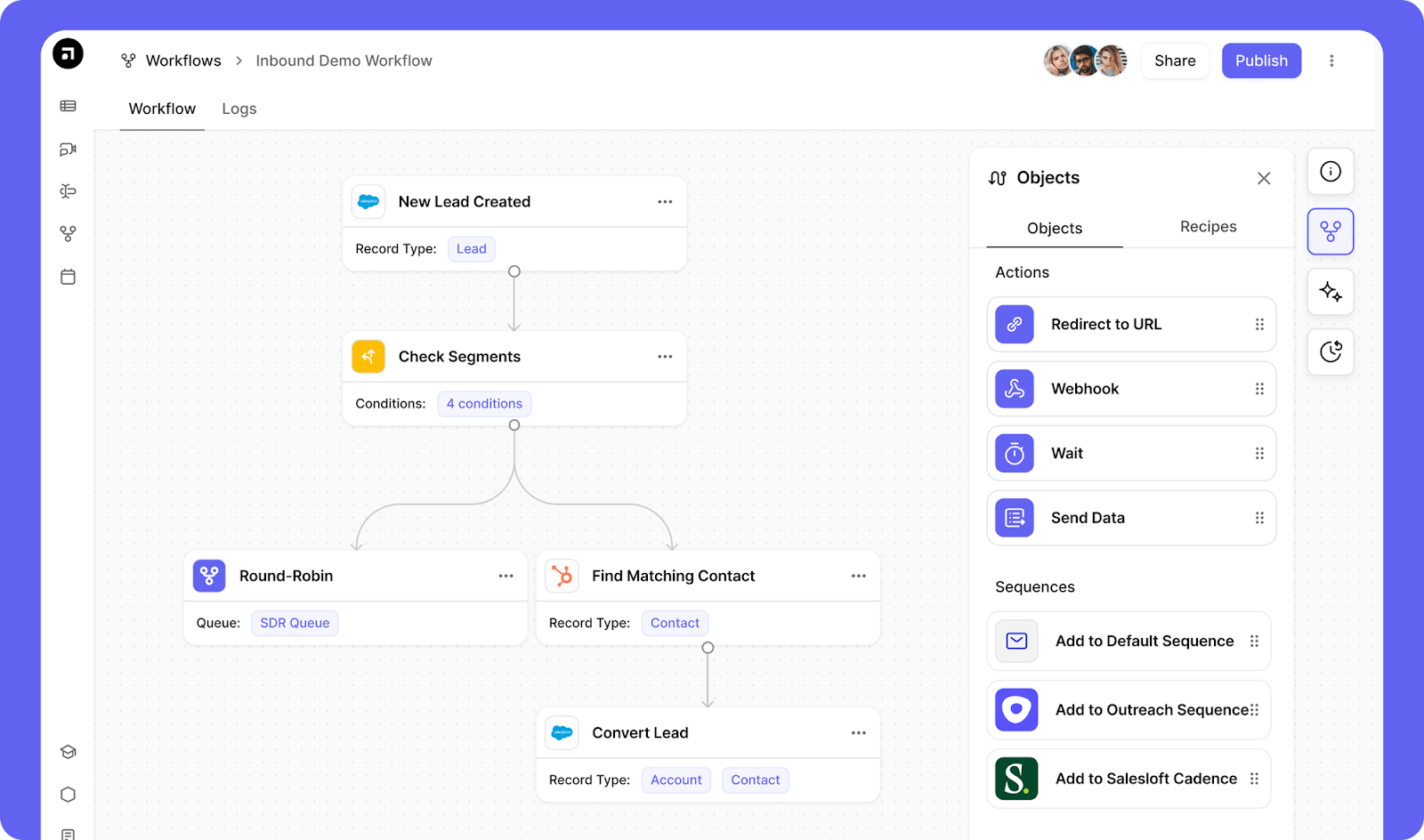
Enforce routing rules automatically
Start by writing routing rules you can audit. Keep them deterministic, not “best effort.”
- Route by territory + segment first (so ownership is predictable)
- Use account ownership history to prevent duplicate outreach and rep conflict
- Apply priority logic last (intent score, inbound vs outbound, target accounts)
Example-in-action: if the lead is mid-market EMEA and the account is unowned → route to the EMEA MM AE. If the account is owned → route to the owner, regardless of territory.
Require complete handoff context
Do not allow “notes-only” handoffs. Make key fields required and validate them before the record can be handed off.
- Qualification inputs (your framework fields)
- Business problem + why now
- Stakeholders (at least decision-maker identified or “unknown” explicitly stated)
- Next step (goal for the first call)
If any of these are missing, the handoff stays with the SDR. That single rule eliminates most pipeline leakage caused by incomplete context.
Trigger fast AE action
Treat speed-to-lead like a monitored system, not a suggestion.
- Auto-create the AE follow-up task on handoff
- Notify instantly (CRM + Slack/email, depending on sales workflow)
- Escalate if the SLA is missed (manager alert, reassignment, or auto-follow-up task)
This protects show rates and prevents qualified meetings from going cold between booking and first contact.
“Use your CRM to create mandatory handoff fields that SDRs have to complete before scheduling meetings. Forces them to ask the right qualifying questions instead of just booking anything that breathes.”
— u/erickrealz, r/EntrepreneurRideAlong
Where Default fits
Default is built for exactly this layer of execution: automated routing, qualification guardrails, and SLA enforcement so handoffs happen with full context and no delay, without relying on manual policing from RevOps.
Metrics to measure SDR to AE handoff success
The best teams treat handoffs like a measurable revenue system, not a “teamwork” problem.
Track these metrics to diagnose friction and improve outcomes:
- Time to first AE contact
How long it takes the AE to engage after the handoff. Increases here usually correlate with lower show rates and lower meeting-to-opportunity conversion. - Handoff acceptance rate
The percentage of handed-off leads that are accepted by an AE within the expected window. Drops here often signal routing issues, unclear ownership rules, or low trust in SDR qualification. - Meeting booked rate
The percentage of SDR-sourced leads that convert into scheduled meetings. This is a top-of-funnel execution baseline, but it is not a quality metric on its own. - Show-up rate
The percentage of scheduled meetings that sales prospects actually attend. Declines typically point to weak urgency, poor qualification, or delayed follow-up after booking. - Opportunity conversion rate
The percentage of meetings that convert into qualified opportunities. This is the clearest signal that your handoff quality is producing real pipeline.
Taken together, these metrics tell you exactly where handoffs are breaking: assignment, acceptance, speed, or qualification. Pick the weakest link, fix it, and watch the downstream numbers move (especially show rate and meeting-to-opportunity conversion). If those two improve, your handoff is doing its job: creating pipeline you can trust.
See how Default supports SDR to AE handoffs
A high-conversion SDR to AE handoff is not about “better communication.” It is about building a system that protects speed, qualification quality, and clean ownership as volume scales.
Default helps you standardize and enforce that system by:
- routing leads using clear rules (territory, segment, ownership, priority)
- requiring complete qualification and context before a handoff is marked complete
- triggering immediate AE follow-up and escalating missed SLAs
This reduces stalled handoffs, protects speed-to-lead, and helps improve show rates and meeting-to-opportunity conversion by ensuring AEs start with full context and clear ownership.
If you want to tighten your handoff process and eliminate pipeline leakage, see how Default fits into your GTM motion.
Conclusion
Former pro Olympic athlete turned growth marketer. Previously worked at Chili Piper and co-founded my own company before joining Default two years ago.
Run revenue as an engineered system
Revamp inbound with easier routing, actionable intent, and faster scheduling